Aller au contenu principal
PRO RDWC Systems
1 produit

PRO RDWC Systems

PRO RDWC Systems: High-Performance Hydroponics

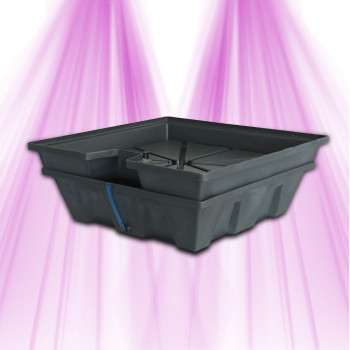
PRO RDWC (Recirculating Deep Water Culture) systems represent the ultimate evolution in hydroponic cultivation. These setups continuously circulate an oxygenated nutrient solution between multiple grow pots connected to a master reservoir. The principle? Your plants develop their roots directly in ...

PRO RDWC Systems: High-Performance Hydroponics

PRO RDWC (Recirculating Deep Water Culture) systems represent the ultimate evolution in hydroponic cultivation. These setups continuously circulate an oxygenated nutrient solution between multiple grow pots connected to a master reservoir. The principle? Your plants develop their roots directly in enriched water, with a constant supply of oxygen that dramatically boosts growth.

Unlike classic DWC systems where each pot operates in isolation, PRO RDWC systems create a closed circuit. This continuous circulation maintains homogeneous parameters (pH, EC, temperature) throughout the entire setup. The result: uniform growth and yields that can exceed those obtained in soil by 30%.

Why choose a PRO RDWC system for your indoor grow

The continuous circulation of the nutrient solution eliminates stagnant areas where bacteria and algae can develop. Constant oxygenation of the roots via air pumps and diffusers creates an optimal root environment. Your plants absorb nutrients more efficiently, leading to explosive vegetative growth and denser flowering.

The major advantage of RDWC is parameter stability. With a master reservoir of 50 to 200 liters depending on the model, pH and EC fluctuations are significantly reduced. No more adjusting each pot individually as in simple DWC. A single control point for your entire setup truly makes a difference in daily management.

PRO systems are distinguished by their robustness: high-quality pumps, reinforced tubing, opaque anti-algae buckets. These setups are designed to run 24/7 for months without a hitch. Maintenance is limited to checking levels and cleaning pump filters.

How to choose your PRO RDWC system

The number of pots determines your primary choice. For a 1m² space, count a maximum of 4 pots. A 1.2m x 1.2m space can accommodate 6 to 9 pots depending on their diameter. 20cm pots are suitable for medium-sized plants, 25cm for large specimens. The rule: better fewer, well-spaced pots than too many crowded ones.

The capacity of the master reservoir influences system stability. A minimum of 10 liters per grow pot, ideally 15-20 liters. A 6-pot system therefore requires a 90 to 120-liter reservoir for optimal operation. The larger the volume, the more stable the parameters remain.

Check the power of the circulation and oxygenation pumps. For circulation, count 300-500 L/h per pot. For oxygenation, a minimum 15W air pump for 4 pots, 25W for 6-8 pots. Diffusers should be ceramic or porous stone for fine and efficient bubbling.

Material quality matters greatly. Opaque food-grade plastic buckets, watertight fittings, UV-resistant hoses. PRO systems often use reputable submersible pumps with a manufacturer's warranty. It's an investment, but one that pays off in the long run.

Frequently asked questions about PRO RDWC systems

How many pots should I choose for my indoor grow space with a PRO RDWC system?

For an 80x80cm space, limit yourself to a maximum of 4 x 20cm pots or 3 x 25cm pots. A square meter can accommodate 4 to 6 pots depending on their size and desired spacing. In a 120x120cm space, you can install 6 to 9 pots in a 2x3 or 3x3 configuration. The classic mistake is trying to cram too many: your plants need space to develop their branching. Better to have 4 well-developed plants than 8 that hinder each other.

How to properly install the RDWC system with the master bucket and pumps?

Place the master reservoir at the lowest level of your setup to facilitate gravity return. Connect each pot to the next with minimum 16mm hoses, with a return to the reservoir from the last pot. The circulation pump is placed in the master reservoir and pushes the solution to the first pot. Install an external air pump with diffusers in each pot and the reservoir. Check the watertightness of all connections before the first watering.

What water temperature should I aim for and do I need a chiller for my RDWC?

The optimal temperature for the nutrient solution is between 18 and 22°C. Above 24°C, oxygen dissolves less effectively, and the risk of pythium increases. In summer or under powerful HPS lights, a chiller often becomes essential. Calculate 100W of cooling per 100L of solution to maintain 20°C with an ambient temperature of 25°C. A less expensive alternative: insulate the reservoir and use rotating frozen water bottles.

What fertilizers and dosages should I use in a PRO RDWC system for hydroponic cultivation?

Exclusively use liquid hydro fertilizers or soluble powders; never use organics, as they cloud the water. Start with an EC of 0.8 during vegetative growth, gradually increasing to 1.4-1.6 during flowering, depending on the varieties. The pH should remain between 5.5 and 6.2 for optimal absorption. Completely renew the solution every 2 weeks at a minimum. Between changes, only adjust the level with pH-adjusted water, no additional fertilizer.

How to maintain and clean an RDWC system to avoid root or pH problems?

Daily check pH, EC, and water level, especially in the first few weeks. Clean air diffusers weekly as they quickly get clogged. Between grows, disassemble the entire system and disinfect with 1% diluted bleach, then rinse thoroughly. Replace hoses every 6 months as they accumulate biofilm and residues. Always keep reverse osmosis water on hand and pH+ and pH- solutions for quick adjustments.


Angezeigt werden 1 - 1 von 1 Artikel
Wozu dient ein PRO RDWC System und welche Hauptvorteile bietet es?
   

Ein PRO RDWC System ist für den Hochleistungs-Hydroponik-Anbau konzipiert. Sein Hauptziel ist es, das Wachstum und den Ertrag Ihrer Pflanzen zu maximieren, indem es ihnen eine konstante und optimierte Versorgung mit Nährstoffen und Sauerstoff bietet. In der Praxis stelle ich fest, dass dies zu kräftigeren Pflanzen, einer außergewöhnlichen Wurzelentwicklung und reichlichen Ernten führt, die oft weit über denen anderer Anbaumethoden liegen.

Was ist der grundlegende Unterschied zwischen einem RDWC-System und einem klassischen DWC-System?
   

Der Hauptunterschied liegt in der Zirkulation der Nährlösung. Bei der klassischen DWC (Deep Water Culture) hat jede Pflanze ihren eigenen statischen oder nahezu statischen Tank. Beim RDWC (Recirculating Deep Water Culture), wie der Name schon sagt, zirkuliert die Lösung ständig zwischen allen Anbauwannen und einem zentralen Reservoir. Dies gewährleistet eine perfekte Homogenität der Nährstoffe und des pH-Werts für alle Ihre Pflanzen, was ich als großen Vorteil für die Stabilität Ihres Anbaus betrachte.

Woher weiß ich, ob ein PRO RDWC System für meinen Anbau geeignet ist?
   

Ich empfehle das PRO RDWC, wenn Sie optimale Leistung und schnelles Wachstum suchen, insbesondere für nährstoffhungrige Pflanzen. Es ist besonders geeignet, wenn Sie bereits Erfahrung in der Hydroponik haben oder bereit sind, Zeit in die Parameterverwaltung zu investieren. Wenn Sie jedoch völlig neu sind, könnte ein einfacheres System wie Ebb & Flow, das ich in diesem Artikel genauer erkläre, ein guter Ausgangspunkt sein, bevor Sie zum RDWC wechseln.

Welche LED-Beleuchtungsleistung sollte ich für ein PRO RDWC System einplanen?
   

Die LED-Beleuchtungsleistung hängt von der Anbaufläche ab, die Ihr RDWC-System abdeckt, und den spezifischen Bedürfnissen Ihrer Pflanzen. Für ein RDWC-System, das auf hohe Leistung abzielt, empfehle ich im Allgemeinen eine hohe Lichtleistung. In der Praxis empfehle ich für eine Fläche von 1m² oft zwischen 300W und 600W hochwertige Vollspektrum-LEDs, oder sogar mehr für bestimmte anspruchsvolle Kulturen, um eine ausreichende Lichtdurchdringung und optimale Entwicklung zu gewährleisten.

Welchen optimalen Abstand sollten LEDs über einem PRO RDWC System haben?
   

Der ideale Abstand zwischen Ihren LEDs und der Spitze Ihrer Pflanzen in einem RDWC-System ist entscheidend und hängt von der Leistung Ihrer Beleuchtung und dem Wachstumsstadium ab. Im Allgemeinen beginne ich in der Wachstumsphase bei etwa 40-60 cm und reduziere dann schrittweise in der Blütephase, wobei ich bei leistungsstarken LEDs bis auf 20-30 cm gehen kann, während ich sorgfältig auf Anzeichen von Hitzestress achte. Ziel ist es, maximale Lichtintensität zu liefern, ohne die Blätter zu verbrennen.

LED-Balken oder LED-Panels: Welche Art von Beleuchtung ist für den RDWC-Anbau zu bevorzugen?
   

Für ein RDWC-System, das oft größere und kräftigere Pflanzen fördert, neige ich im Allgemeinen zu LED-Panels vom Typ Balken. Was ich oft sehe, ist, dass LED-Balken eine bessere Gleichmäßigkeit des Lichts über das gesamte Blätterdach bieten, was entscheidend ist, um Schattenbereiche zu vermeiden und eine homogene Entwicklung aller Pflanzen zu gewährleisten. Kompakte Panels können für kleine Flächen effektiv sein, aber um den Raum und das Licht in einem RDWC zu optimieren, sind Balken oft die bessere Wahl.

Welches LED-Spektrum sollte ich für ein RDWC-System in der Wachstums- und Blütephase wählen?
   

Für die Wachstumsphase mit einem RDWC-System empfehle ich ein blau-reiches Spektrum, das eine robuste vegetative Entwicklung und kurze Internodien fördert. Für die Blütephase sollte man zu einem rot- und orange-reicheren Spektrum wechseln, mit einer Präsenz von Grün und Weiß für die Photosynthese, was die Produktion von Blüten und Früchten anregt. Viele moderne LED-Panels bieten einstellbare Spektren oder Wachstums-/Blütemodi, was die Verwaltung erheblich vereinfacht.

Blog navigation

Neueste Beiträge

Welche Leistung braucht eine LED-Pflanzenlampe für Grow-Einsteiger?

Welche Watt-Leistung braucht eine LED-Pflanzenlampe zum Einstieg? Echte Watt, W/m², PPFD, 60x60-Fläche: der...

Lire la suite
VIVOSUN Grow Cam 6mm 2K QHD WiFi-Kamera für deine Pflanzenzucht

Hast du auch keinen Bock mehr auf die Panik, wenn du mal nicht bei deinen Pflanzen bist? Mit der VIVOSUN Grow Cam 6mm...

Lire la suite
STOP à la Tourbe ! Découvrez les 4 Meilleurs Substrats Écologiques pour une Culture Indoor Explosive

Le monde du jardinage connaît une transformation silencieuse mais profonde. Face à l'urgence climatique et à la prise...

Lire la suite
    Umtausch LED-Pflanzenlicht innerhalb von 30 Tagen

    Umtausch innerhalb
    von 14 Tagen

    Kostenloser Versand von LED-Pflanzenlampen

    Kostenloser Versand
    ab 100€*

    Schnelle Lieferung von LED-Pflanzenlampen

    Lieferung
    in 24 bis 48 Stunden

    Sichere
    Zahlung

    Zahlung in 3 Raten ohne Gebühren für LED-Pflanzenlampen

    Zahlungserleichterung

    Bestpreisgarantie für LED-Pflanzenlampen

    Bestpreisgarantie

    Garantie für LED-Pflanzenlampen

    GrowLED
    Garantie

    Treuepunkte für LED-Pflanzenlampen

    Treuepunkte