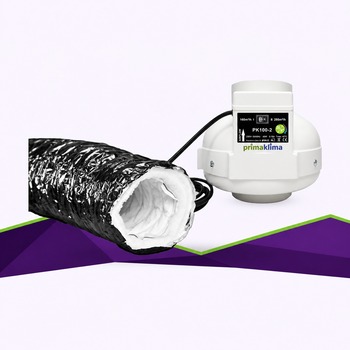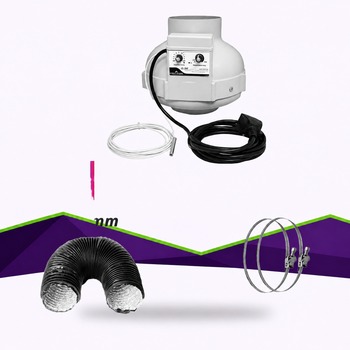






























Prima Klima PK 125 L – extraction kit: extractor fan + PF PRO Ø125 500 m³/h…
In 3 Modellen erhältlich
Auf Lager · Versand innerhalb von 24 Std.
213,26 € 224,48 € oder 3× 71,09 €

Artikel wurde in den Korb gelegt
Ça pousse dans le bon sens

34 Produkte
Ventilation kits bring together all the essential elements to create an efficient aeration system in your grow space. Say goodbye to the headache of choosing each component separately: extractor, carbon filter, ducts, and accessories are already matched to work together. This guarantees a coherent setup that flawlessly manages temperature, humidity, and odors.
Frankly, assembling a ventilation system yourself can quickly become a nightmare. Between a 125mm extractor and a 100mm filter that don't match, or undersized ducts that create pressure drops... Mistakes are costly. A ventilation kit eliminates these risks by offering components calibrated together. The extractor has exactly the necessary airflow for the carbon filter, the ducts have the correct diameter, and often clamps are included. The result: a setup that works right out of the box, with optimal performance for your grow space.
From a budget perspective, it's also smart. Manufacturers can offer tighter prices by selling components in bundles. And in terms of stock, no unpleasant surprises: everything arrives at the same time, ready to install. For beginners, it's reassuring. For experienced growers, it's a huge time-saver.
Sizing is fundamental. For a 60x60x160cm grow tent (0.6m³), count on a minimum of 150-200 m³/h extraction flow. But beware of pressure drops: a carbon filter can halve the airflow. So a 400 m³/h extractor with a filter will actually provide more like 200 m³/h. That's why kits are pre-calculated based on space volumes.
Diameter also matters greatly. 100mm is sufficient for small grow tents up to 0.8m³. 125mm covers spaces from 0.8 to 2m³. Beyond that, move to 150mm or 200mm. The larger the diameter, the less turbulence and noise. And speaking of noise: some kits include soundproof ducts or silent extractors. Essential if you're growing in an apartment.
Also check what's included: carbon filter, aluminum ducts, clamps, sometimes even a speed controller. High-end kits often offer active intake with an air intake fan, which is more efficient than passive intake for larger volumes.
For a 60x60x160cm grow tent, you have a volume of 0.576m³. The basic rule: renew the air 60 to 100 times per hour, which is 35 to 58 m³/h theoretically. But this doesn't account for pressure drops from the carbon filter (halving the flow), duct elbows (10% per 90° elbow), and duct length (5% per meter). In practice, choose an extractor of 150-200 m³/h for this size grow tent. Kits for 60x60 grow tents generally include extractors of 160-190 m³/h, perfect for compensating for these losses.
Ideally: carbon filter inside, extractor outside. The filter captures odors better when it directly draws air from the grow tent, and it benefits from the controlled temperature of the grow space. The extractor outside avoids adding its heat to the grow tent and facilitates evacuation to the exterior. If space is limited, everything can go outside, but connect the filter with a short duct to limit losses. Avoid putting the extractor inside the grow tent: it heats up and takes up valuable space.
Passive intake uses the negative pressure created by the extractor to draw fresh air through simple openings. Simple and quiet, but limited for large volumes or confined spaces. Active intake adds an air intake fan that pushes fresh air into the grow tent. More efficient for maintaining balanced pressure and stable temperature, especially in summer. For a grow tent up to 1m³, passive intake is sufficient. Beyond that, or if your grow room is hot, opt for active intake. Kits with active intake are more expensive but offer better climate control.
Use soundproof ducts for at least 2 meters after the extractor to absorb vibrations. Avoid 90° elbows that create noisy turbulence: prefer two 45° elbows. For exhaust, an outdoor vent (window, existing HVAC) remains ideal. In an apartment, exhaust into an uninhabited room with an HVAC system. Install the extractor on silent blocks to isolate vibrations from the floor. And above all, never neglect the carbon filter: even with outdoor exhaust, odors can travel back through the ducts.
A carbon filter lasts 12 to 18 months depending on use, but good maintenance can extend its life. Regularly vacuum the external pre-filter to prevent dust from clogging the carbon pores. Every 3-4 months, disassemble the filter and gently tap it to dislodge embedded dust. Avoid water, which would destroy the activated carbon. Monitor its effectiveness: if odors start to pass through, the carbon is saturated. A well-maintained filter in a clean environment can last 24 months, compared to 6-8 months if neglected.
In 3 Modellen erhältlich
In 3 Modellen erhältlich
In 2 Modellen erhältlich
In 3 Modellen erhältlich
In 3 Modellen erhältlich
In 3 Modellen erhältlich
In 2 Modellen erhältlich
In 2 Modellen erhältlich
In 3 Modellen erhältlich
Hilfe & Beratung
Zu Ventilation Packs — klicken Sie auf eine Frage, um die Antwort zu sehen.
Um ein Belüftungspaket auszuwählen, empfehle ich Ihnen, die Größe Ihres Anbauraums, die Leistung Ihrer Beleuchtung und Ihre Anforderungen an die Geräuschdiskretion zu berücksichtigen. Die Pakete sind so konzipiert, dass sie komplett sind, einschließlich Abluftventilator, Aktivkohlefilter und Schläuchen, was die Installation erheblich vereinfacht und eine gute Synergie der Komponenten gewährleistet. Ziehen Sie auch die Option eines leisen Pakets in Betracht, wenn Lärm ein großes Anliegen für Sie ist.
Die Leistung des Abluftventilators ist entscheidend. Ich empfehle im Allgemeinen, ein Absaugvolumen anzustreben, das in der Lage ist, die Luft in Ihrer Box alle 1 bis 3 Minuten zu erneuern. Um dies zu berechnen, multiplizieren Sie die Länge, Breite und Höhe Ihrer Box, um ihr Volumen in m³ zu erhalten, und multiplizieren Sie diese Zahl dann mit 60 (für eine Erneuerung pro Minute) oder mit 20 (für eine Erneuerung alle 3 Minuten). Vergessen Sie nicht, dass das Vorhandensein eines Aktivkohlefilters oder eines langen Kanals die Effizienz des Abluftventilators verringern kann, planen Sie also einen kleinen Spielraum ein.
Ein Belüftungspaket hat mehrere wesentliche Funktionen im Indoor-Anbau. Erstens ermöglicht es die Regulierung von Temperatur und Luftfeuchtigkeit, wodurch Hitzestress und die Entwicklung von Schimmel vermieden werden. Zweitens sorgt es für eine konstante Zufuhr von frischem CO2 für die Photosynthese Ihrer Pflanzen. Schließlich neutralisiert es dank des in vielen Paketen enthaltenen Aktivkohlefilters Gerüche, ein nicht zu vernachlässigender Aspekt für die Diskretion Ihres Anbaus. Es ist wirklich der Schlüssel zu einer stabilen und wachstumsfördernden Umgebung.
Die Berechnung der benötigten Luftabsaugung ist recht einfach: Messen Sie das Volumen Ihres Anbauraums (Länge x Breite x Höhe in Metern). Dann multipliziere ich dieses Volumen mit 60, um den Luftstrom in m³/Stunde zu erhalten, der erforderlich ist, um die Luft einmal pro Minute zu erneuern. Zum Beispiel beträgt das Volumen für eine Box von 1m x 1m x 2m 2m³, daher benötigen Sie einen Abluftventilator von mindestens 120 m³/h. Wenn Sie einen Aktivkohlefilter oder lange Schläuche verwenden, empfehle ich Ihnen, diesen Wert um etwa 20% zu erhöhen, um Druckverluste auszugleichen.
Die Platzierung des Aktivkohlefilters und des Abluftventilators ist wichtig für die Effizienz. Ich empfehle immer, den Aktivkohlefilter im Inneren der Box, oben, zu platzieren, damit er die wärmste und geruchsintensivste Luft aufnimmt. Der Abluftventilator kann direkt nach dem Filter, innerhalb oder außerhalb der Box platziert werden, je nach verfügbarem Platz und Ihrem Bedarf an Geräuschdiskretion. Die Idee ist, einen Luftstrom zu erzeugen, der die verbrauchte Luft durch den Filter ansaugt und dann ausstößt. Sie finden Optionen mit oder ohne Aktivkohlefilter, wie unsere Pakete ohne Filter, wenn Gerüche kein Problem darstellen.
Für eine Box von 100x100 cm (also 1m x 1m), wenn sie 2m hoch ist, beträgt das Volumen 2m³. Ich würde Ihnen einen Abluftventilator empfehlen, der mindestens 120 m³/h (2m³ x 60 Minuten) bewältigen kann. Für eine optimale Leistung und um den Druckverlust durch den Aktivkohlefilter und die Schläuche auszugleichen, würde ich jedoch eher einen Abluftventilator von 150 bis 200 m³/h anstreben. Viele Pakete mit Aktivkohlefilter sind perfekt für diese Boxgröße geeignet und bieten Ihnen die nötige Leistung für eine gesunde Umgebung.
Ihre Antwort nicht gefunden? 01 88 33 45 52 oder per Nachricht.

Umtausch innerhalb
von 14 Tagen

Kostenloser Versand
ab 100€*

Lieferung
in 24 bis 48 Stunden

Sichere
Zahlung

Zahlungserleichterung

Bestpreisgarantie

GrowLED
Garantie

Treuepunkte