





























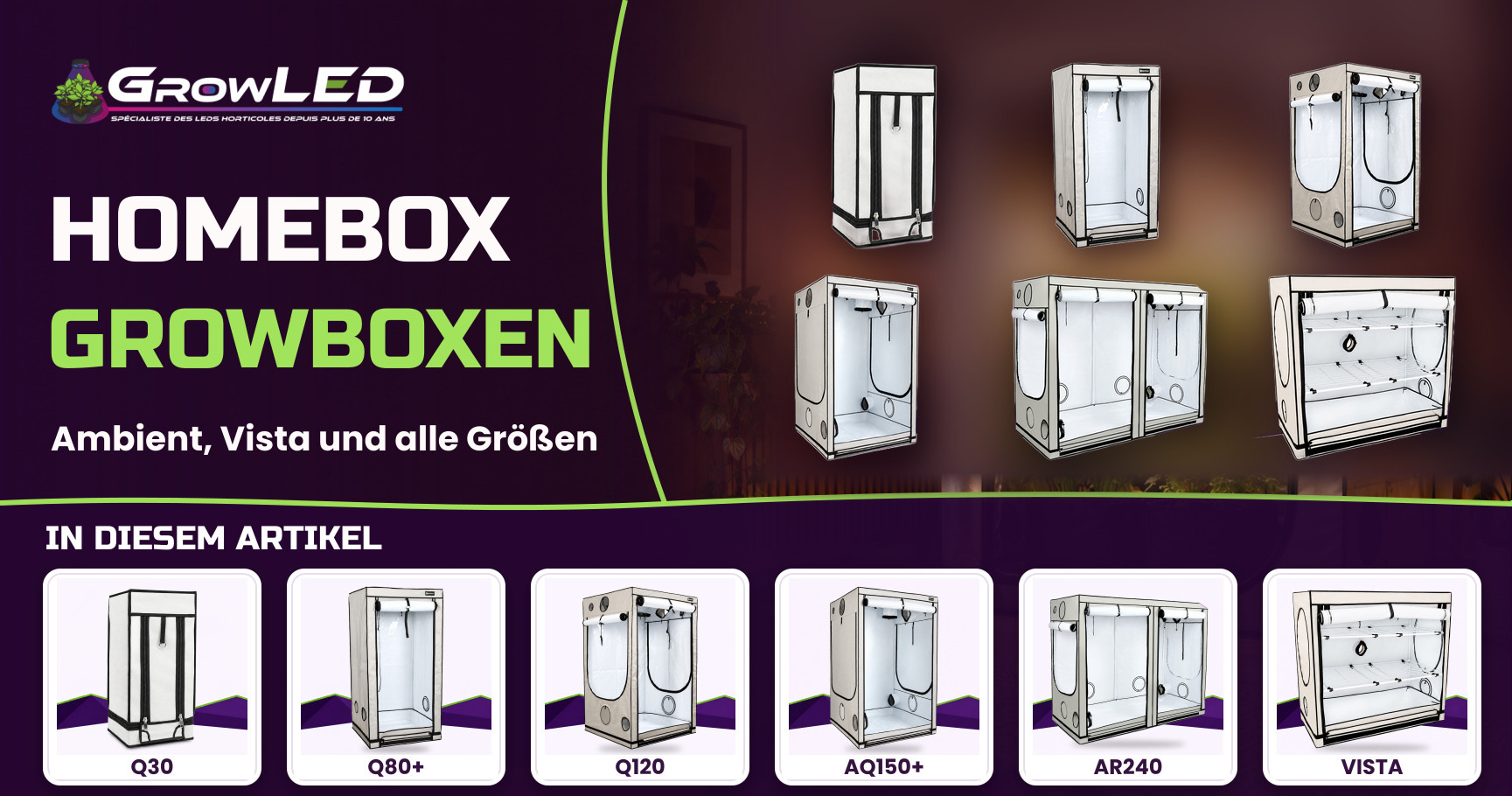
HomeBox
HomeBox Vista Medium – Growbox 125x65x120 cm
In 3 Modellen erhältlich
Auf Lager · Versand innerhalb von 24 Std.
269,00 € oder 3× 89,67 €

Artikel wurde in den Korb gelegt
Ça pousse dans le bon sens

3 Produkte
Double-tier grow tents are revolutionizing indoor cultivation by allowing you to grow on two distinct levels within the same space. This ingenious configuration offers you the possibility of simultaneously managing two grow cycles: vegetative growth on the upper level and flowering on the lower level, or two different varieties with their own lighting needs. No more wasted time between cycles; your production becomes continuous.
These vertical setups prove particularly effective for growers with limited floor space but sufficient ceiling height. With typical dimensions of 90x60x160cm or 150x80x200cm, they literally double your growing area without encroaching further on your room.
The main advantage lies in optimizing vertical space. Where a classic tent limits you to a single growing level, the double-tier system intelligently exploits the available height. Each compartment has its own ventilation and hanging points for lighting, creating two completely independent growing environments.
Productivity is significantly improved. While your plants finish flowering on the lower level, you can already prepare the next generation for vegetative growth on the upper level. This permanent rotation eliminates downtime and maintains a regular harvest flow. Experienced growers particularly appreciate this continuity, which optimizes the return on investment of their setup.
The physical separation of the two levels also offers significant health benefits. In case of a problem on one level (pests, disease), the other level remains protected by the intermediate partition. This isolation limits the spread of problems and facilitates targeted treatments.
Dimension is the first selection criterion. 90x60cm models are perfect for confined spaces and allow you to grow 2-4 plants per level depending on the technique used. 150x80cm versions offer more space for 4-6 plants per level and facilitate handling inside the tent.
The height of each compartment determines your growing possibilities. Allow at least 80cm of net height per level for proper plant development, deducting the space occupied by lighting and ventilation. Check that your room's ceiling height allows for the complete installation of the structure.
The quality of the reflective fabric plays a crucial role in light efficiency. Opt for Mylar or diamond fabrics with a reflection rate greater than 95%. The fabric thickness (minimum 210D) ensures durability and light impermeability between the two levels.
Ventilation systems must be adapted to the double volume. Each level requires its own extraction, generally with 100mm or 125mm ducts depending on the dimensions. Plan for extractors of at least 200m³/h per level to ensure sufficient air exchange.
The choice depends on your available space and production goals. The 90x60cm requires only 0.54m² of floor space and is suitable for 2-3 plants per level in pots up to 11L. It fits perfectly in closets or small rooms. The 150x80cm occupies 1.2m² but allows for 4-6 plants per level in 18L pots, offering a higher yield. Also, check that your ceiling height accommodates the 200cm of the larger version compared to 160cm for the compact one.
The upper level is generally intended for vegetative growth with 18/6 lighting (CFL or low-power LED), while the lower level accommodates flowering at 12/12 with more powerful lighting. Install separate extractors for each level with independent exhaust ducts to the outside. The intermediate partition ensures light impermeability, crucial for respecting photoperiods. Use distinct timers to manage the lighting cycles of each compartment without interference.
Each level requires its own extraction system with a minimum flow rate of 200m³/h for a 90x60 and 300m³/h for a 150x80. Install an extractor at the top of each compartment with an independent exhaust duct. Add oscillating fans (15cm clip-fan) in each level to homogenize the air. Passive intake through the lower openings is usually sufficient, but monitor humidity, which should not exceed 60% during flowering. A compact dehumidifier may be necessary depending on your local climate.
Assembly alone is possible but requires more time and attention. The metal structure is easy to assemble by following the instructions, but installing the fabric and especially the intermediate partition is more delicate for one person. Allow 3-4 hours alone versus 2 hours with two people. The most critical part concerns securing the central shelf, which supports the weight of the upper level. Make sure all tubes are properly fitted and tightened before stretching the fabric. A second person greatly facilitates handling large fabrics without creasing them.
Partially disassemble the fabric to access all corners of each level. First, vacuum plant debris and dust, then clean the surfaces with a solution of water and black soap. Then disinfect with 70% alcohol or a diluted bleach solution (1%), focusing on corners and fasteners where moisture can accumulate. Allow to dry completely before reassembling the fabric. Take advantage of this cleaning to check the condition of zippers and seams, which are sensitive points on this type of installation. Rigorous maintenance after each cycle prevents the accumulation of pathogens between levels.
In 3 Modellen erhältlich
In 4 Modellen erhältlich
In 4 Modellen erhältlich
Hilfe & Beratung
Zu Double-story grow box — klicken Sie auf eine Frage, um die Antwort zu sehen.
Eine zweistöckige Growbox, wie der Name schon sagt, ist darauf ausgelegt, den Anbauraum zu maximieren, indem sie den Anbau auf zwei verschiedenen Ebenen ermöglicht. In der Praxis bedeutet dies, dass Sie gleichzeitig zwei verschiedene Wachstumsphasen verwalten können, zum Beispiel junge Pflanzen im Wachstum auf der oberen Etage und blühende Pflanzen auf der unteren Etage, oder auch zwei Sorten mit spezifischen Bedürfnissen. Dies ist eine ideale Lösung für Züchter, die ihren Ertrag auf begrenztem Raum optimieren möchten.
Der Hauptunterschied liegt in der Kapazität und Vielseitigkeit. Eine einstöckige Box bietet einen einzigen Anbauraum, während eine zweistöckige Box diesen Raum vertikal in zwei separate Abteile unterteilt. Dies ermöglicht es Ihnen, verschiedene Lebenszyklen für Ihre Pflanzen zu verwalten oder Sorten mit unterschiedlichen Licht- und Klimaanforderungen gleichzeitig anzubauen, was mit einer einstöckigen Box unmöglich ist. Ich finde, das ist ein großer Vorteil für erfahrene Züchter oder diejenigen, die eine kontinuierliche Produktion wünschen.
Die ideale Größe hängt vom verfügbaren Platz bei Ihnen zu Hause und der Anzahl der Pflanzen ab, die Sie anbauen möchten. Wenn Sie Anfänger sind oder wenig Platz haben, kann eine kompakte Box (z.B. 60x60x120 cm) ein ausgezeichneter Ausgangspunkt sein. Für größere Produktionen empfehle ich, größere Abmessungen anzustreben, wie 120x60x180 cm oder mehr. Vergessen Sie nicht, die Deckenhöhe für jede Etage zu berücksichtigen, besonders wenn Sie Pflanzen anbauen, die in der Blütezeit stark in die Höhe wachsen.
Die Anzahl der Pflanzen hängt hauptsächlich von der Größe jedes Abteils und der von Ihnen verwendeten Anbaumethode ab. Im Allgemeinen können Sie im Wachstumsabteil mehr junge Pflanzen unterbringen als im Blüteabteil, wo die Pflanzen größer sind und mehr Platz benötigen. Zum Beispiel würde ich sagen, dass in einem 60x60 cm großen Abteil 1 bis 4 blühende Pflanzen denkbar sind, während der gleiche Raum im Wachstum 4 bis 9 junge Pflanzen aufnehmen könnte. Wichtig ist, nicht zu überladen, um eine gute Luftzirkulation und ausreichend Licht für jede Pflanze zu gewährleisten.
Die Konfiguration der Regale ist entscheidend für die Effizienz Ihrer Box. Ich empfehle, das Regal so zu positionieren, dass unten genügend Höhe für die Blüte bleibt, da die Pflanzen dort ihre maximale Größe erreichen. Die obere Etage, die oft für Wachstum oder Stecklinge verwendet wird, kann eine geringere Höhe haben. Stellen Sie sicher, dass das Regal stabil ist und den Zugang zu den Pflanzen oder die Installation Ihrer Beleuchtung und Belüftung nicht behindert. Die Flexibilität der Höhenverstellung ist ein echter Pluspunkt.
Ihre Antwort nicht gefunden? 01 88 33 45 52 oder per Nachricht.

Umtausch innerhalb
von 14 Tagen

Kostenloser Versand
ab 100€*

Lieferung
in 24 bis 48 Stunden

Sichere
Zahlung

Zahlungserleichterung

Bestpreisgarantie

GrowLED
Garantie

Treuepunkte

